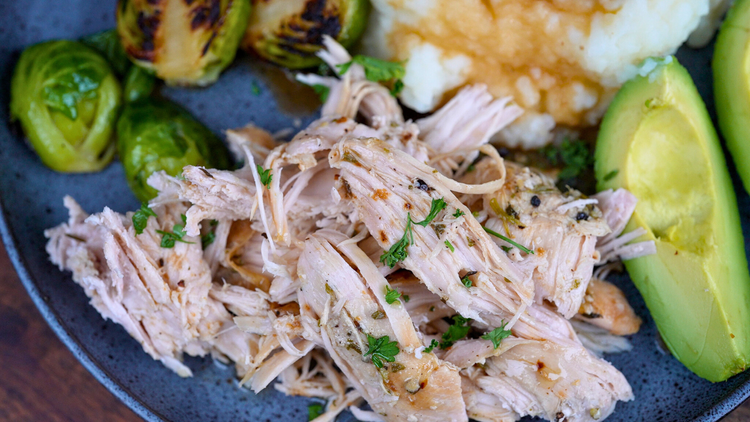
Ingredients
Method
- Preparation:Gently separate the turkey skin from the flesh, being careful not to tear the skin.Peel the full head of garlic.
- Gently separate the turkey skin from the flesh, being careful not to tear the skin.
- Peel the full head of garlic.
- Herb Marinade:In a small food processor, combine the garlic cloves, fresh Sage, Rosemary, Thyme, lemon zest, and lemon juice.Add olive oil, ground mustard, kosher salt, and freshly ground black pepper.Pulse until well combined.
- In a small food processor, combine the garlic cloves, fresh Sage, Rosemary, Thyme, lemon zest, and lemon juice.
- Add olive oil, ground mustard, kosher salt, and freshly ground black pepper.
- Pulse until well combined.
- Garlic Butter Mixture:Transfer the herb mixture to a mixing bowl.Combine with room temperature butter until thoroughly mixed.
- Transfer the herb mixture to a mixing bowl.
- Combine with room temperature butter until thoroughly mixed.
- Stuff and Prepare Turkey:Carefully stuff the garlic butter mixture under the turkey skin and inside the turkey.Preheat the oven to 325°F (165°C).
- Carefully stuff the garlic butter mixture under the turkey skin and inside the turkey.
- Preheat the oven to 325°F (165°C).
- Roasting:Place the turkey breast in a roasting pan.Pour one cup of white wine or chicken stock into the pan to provide moisture.Season with kosher salt and freshly ground black pepper.Insert an instant-read thermometer into the thickest part of the turkey breast.
- Place the turkey breast in a roasting pan.
- Pour one cup of white wine or chicken stock into the pan to provide moisture.
- Season with kosher salt and freshly ground black pepper.
- Insert an instant-read thermometer into the thickest part of the turkey breast.
- Roast:Roast the turkey at 325°F for approximately 2 hours, or until the internal temperature reaches 165°F.
- Roast the turkey at 325°F for approximately 2 hours, or until the internal temperature reaches 165°F.
- Rest and Serve:Cover the roasted turkey breast with aluminum foil and let it rest for 10-15 minutes before carving.Once rested, carve the turkey and enjoy the tender, flavorful meat.
- Cover the roasted turkey breast with aluminum foil and let it rest for 10-15 minutes before carving.
- Once rested, carve the turkey and enjoy the tender, flavorful meat.
Nutrition
Notes
Pro Tips:
Buy a bone-in turkey breast instead of boneless because the bone acts as a natural heat conductor, cooking the meat more evenly from the inside out while keeping it incredibly moist throughout the long roasting process. Create herb paste pockets by gently loosening the skin and spreading the garlic-herb mixture directly on the meat, not just under the skin surface, because this creates multiple flavor layers that penetrate deeper as the turkey roasts. After years of making this, I learned to tent the breast with foil only when the skin reaches your desired golden color, not from the start, because you want that initial high-heat browning to lock in the herb crust before gentle cooking. Use fresh thyme over dried for this recipe because the oils in fresh thyme leaves slowly release during the long roasting time, perfuming the meat, while dried thyme can become dusty and lose potency in extended heat.
Buy a bone-in turkey breast instead of boneless because the bone acts as a natural heat conductor, cooking the meat more evenly from the inside out while keeping it incredibly moist throughout the long roasting process. Create herb paste pockets by gently loosening the skin and spreading the garlic-herb mixture directly on the meat, not just under the skin surface, because this creates multiple flavor layers that penetrate deeper as the turkey roasts. After years of making this, I learned to tent the breast with foil only when the skin reaches your desired golden color, not from the start, because you want that initial high-heat browning to lock in the herb crust before gentle cooking. Use fresh thyme over dried for this recipe because the oils in fresh thyme leaves slowly release during the long roasting time, perfuming the meat, while dried thyme can become dusty and lose potency in extended heat.
