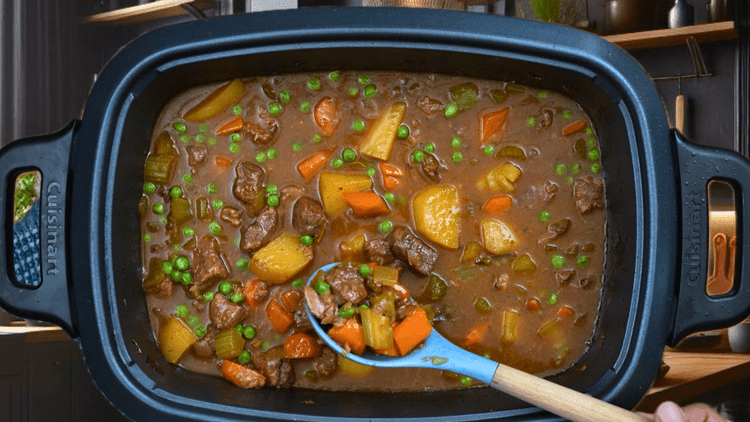
Ingredients
Method
- Prep the BeefPat stew meat dry with paper towels.Toss with flour, salt, and pepper until evenly coated.
- Pat stew meat dry with paper towels.
- Toss with flour, salt, and pepper until evenly coated.
- Brown the MeatSet slow cooker to Sauté/High.Heat olive oil and brown beef in batches, 3–4 minutes per side.Transfer browned beef to a plate.
- Set slow cooker to Sauté/High.
- Heat olive oil and brown beef in batches, 3–4 minutes per side.
- Transfer browned beef to a plate.
- Build FlavorAdd onion and garlic to the pot; cook 2–3 minutes until fragrant.Stir in tomato paste; cook 1 minute.Pour in red wine, scraping up browned bits.
- Add onion and garlic to the pot; cook 2–3 minutes until fragrant.
- Stir in tomato paste; cook 1 minute.
- Pour in red wine, scraping up browned bits.
- Combine IngredientsReturn beef to the slow cooker.Add carrots, potatoes, celery, Worcestershire, beef broth, thyme, rosemary, and bay leaves.Stir everything together.Before closing the lid, add the adobo seasoning and sazón packet. Stir gently to incorporate.
- Return beef to the slow cooker.
- Add carrots, potatoes, celery, Worcestershire, beef broth, thyme, rosemary, and bay leaves.
- Stir everything together.
- Before closing the lid, add the adobo seasoning and sazón packet. Stir gently to incorporate.
- Slow CookCover and cook on LOW for 8–9 hours or HIGH for 4–5 hours, until beef is tender and vegetables are soft.
- Cover and cook on LOW for 8–9 hours or HIGH for 4–5 hours, until beef is tender and vegetables are soft.
- Finish the StewIn the last 20 minutes, stir in frozen peas.For thicker stew, mix 2 tablespoon cornstarch with 2 tablespoon cold water and stir in now.Remove bay leaves before serving.
- In the last 20 minutes, stir in frozen peas.
- For thicker stew, mix 2 tablespoon cornstarch with 2 tablespoon cold water and stir in now.
- Remove bay leaves before serving.
- ServeGarnish with fresh parsley.Serve hot with crusty bread.
- Garnish with fresh parsley.
- Serve hot with crusty bread.
Nutrition
Notes
Pro Tips:
Choose chuck roast with visible white marbling throughout because those fat streaks contain collagen that melts into gelatin during slow cooking, creating the silky texture that makes great stew cling to your spoon instead of running off like soup. After years of making this recipe, I've found that cutting your beef into slightly uneven pieces – some 1-inch, some 1.5-inch – gives you better texture variation. The smaller pieces break down more, thickening the stew, while larger pieces stay tender but intact. Sear your beef in batches with plenty of space between pieces because overcrowding creates steam instead of browning. Those dark, caramelized bits stuck to your pan become the flavor foundation when you deglaze – skip this and your stew tastes flat. Add your root vegetables in order of cooking time: carrots first, then potatoes 2 hours later, because carrots take longer to break down and release their natural sugars that balance the rich beef flavors perfectly.
Choose chuck roast with visible white marbling throughout because those fat streaks contain collagen that melts into gelatin during slow cooking, creating the silky texture that makes great stew cling to your spoon instead of running off like soup. After years of making this recipe, I've found that cutting your beef into slightly uneven pieces – some 1-inch, some 1.5-inch – gives you better texture variation. The smaller pieces break down more, thickening the stew, while larger pieces stay tender but intact. Sear your beef in batches with plenty of space between pieces because overcrowding creates steam instead of browning. Those dark, caramelized bits stuck to your pan become the flavor foundation when you deglaze – skip this and your stew tastes flat. Add your root vegetables in order of cooking time: carrots first, then potatoes 2 hours later, because carrots take longer to break down and release their natural sugars that balance the rich beef flavors perfectly.
